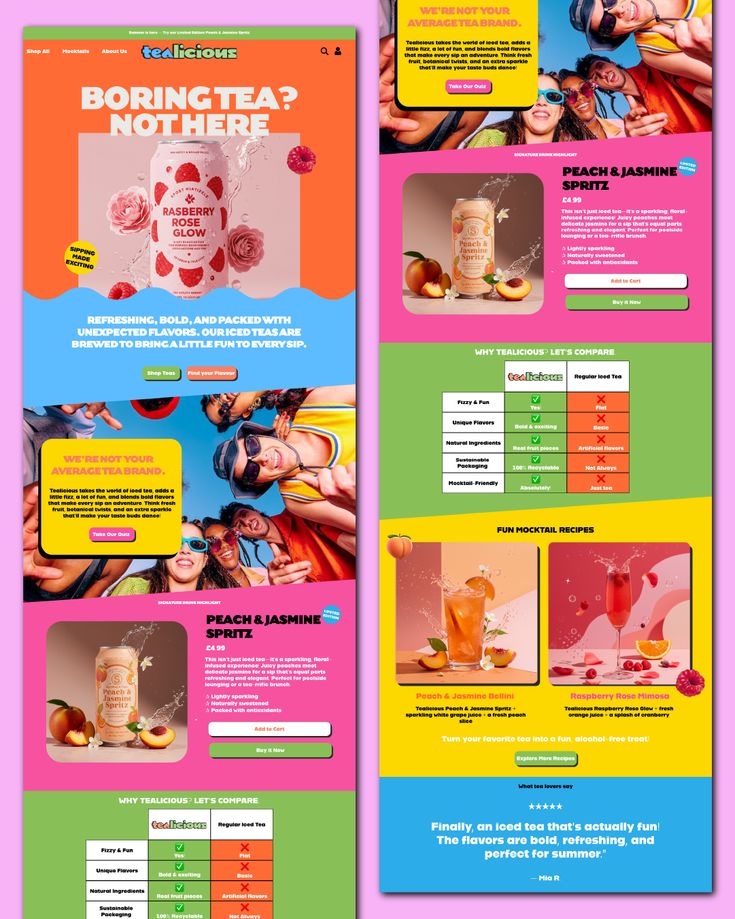
You didn’t build your business to stay small. You built it because you saw something. A gap, an opportunity, a product that deserved to exist, so you went after it. And it worked. You have customers and the demand.
But somewhere between launching and now, your website got left behind.
Not dramatically, or in a way that broke everything. Just in the way that things do when you’re too busy building the actual business to notice.
Here are five signs it’s happening, and what it’s costing you without you realising. (And sign #4 is the most juiciest)
1. Your loyal customers trust you. New customers don’t.
Your repeat customers don’t need convincing. They know your product, they’ve experienced it, they come back because they already believe. But here’s the problem: your website was built for them, not for the stranger discovering you for the first time.
That first-time visitor doesn’t have the context. They didn’t see the viral TikTok. They weren’t referred to by a friend who raved about the product. They landed on your site cold, and within a few seconds they’re deciding whether to trust you enough to buy.
If your website still looks like it did, when you had fewer products, less proof, and a smaller story to tell, that new customer is going to hesitate. Not because your product isn’t good. But because the site doesn’t communicate that it’s good enough, clearly enough, or quickly enough, for someone who doesn’t already know.
You’re not losing customers dramatically. You’re just not gaining new ones as easily as you should be. And the friction causing this is an outdated website.
2. New products keep getting added. The story behind them doesn’t.
You launched something new. You uploaded the photos, set the price, and added it to your store.
But here’s what the customer sees: a new product sitting in a collection with no context, no explanation of what makes it different, no reason to care beyond the fact that it exists. It’s giving: here you go, I’ve added something new, take a look if you want.
Every product you sell has a reason behind it. So when new collections are added to your site without updated copy, without a new homepage layout that explains what this is and who it’s for, the product just sits there. Without any context.
3. Your brand has evolved. Your website fonts and colours haven’t.
You’ve updated your packaging. Maybe you’ve refined your branding. Your prices have gone up to align with your international orders, premium positioning, a product that’s genuinely innovative.
But your website still has the basic web friendly fonts that don’t match your brand. Or only one out of your five primary brand colours are visible on the site (or your site is completely black and white). The visuals do not match the brand guidelines you previously invested in.
It’s not a dramatic mismatch. Most customers won’t consciously notice it. But it creates a subtle feeling that something is slightly off. That the site doesn’t quite feel as premium or innovative as the product itself. And that feeling, even when it’s subconscious, affects whether someone buys.
Your website is being treated as a platform to upload information rather than a platform that presents your brand.
4. People are discovering you but not buying.
Someone finds you on their For You Page. A recommendation. They Google something and you come up. They arrive on your site, but they leave without buying, because they don’t know what to do next.
This is the sign that gets misdiagnosed most often. Founders assume the problem is traffic. That they need more people to discover them. But the real problem is conversion (which by definition is when a visitor completes a desired action, like making a purchase or subscribing to a newsletter). The people who do discover them aren’t being guided to the right product for their specific need.
Think about what a new customer actually needs when they land on your site. If you sell underwear in five different nude shades, they need to know which shade is theirs before they can confidently buy. If you sell period care products, a new customer needs to know whether the light flow pad or the postpartum pad is the one for them. So if the product page just lists small, medium, large, without any other context, they’re guessing. They pick randomly, or they don’t pick at all.
If you sell West African sauce and someone’s never tried West African food before, they don’t know whether to go mild or spicy. That unanswered question is the reason they close the tab.
Your website’s job is to answer the question the customer hasn’t asked out loud yet. If it isn’t doing that, you get the attention but not the sale.
5. Word of mouth is doing the work your website should be doing.
Your best customers are out there telling people about you. They recommend you unprompted. Sending friends and family to your page. And that’s wonderful, as it means the product is doing what it’s supposed to do.
But word of mouth has a ceiling. It scales with your customers’ networks, not with your brand’s potential. And when those referred visitors arrive on your site, they need the site to close the sale; not rely on the person who sent them to have already done all the convincing in advance.
If your website can’t convert a potential customer without the context of a personal recommendation, it won’t convert a new visitor.
The goal isn’t to replace word of mouth. It’s to build a website that does what word of mouth does: builds trust, communicates value, and guides someone toward a confident purchase.
The common thread is that…
Every one of these signs points to the same thing: a website that was built for the version of your brand that existed when you first launched, not the version that exists today.
Your business grew. Your customers grew. Your products, your pricing, your packaging, your story has all evolved. The website just didn’t keep up.
And that gap, between who you are now and what your website says you are, is where opportunities quietly disappear with every hesitant first-time visitor.
If you’re reading this and recognise your brand fits in more than one of these signs, it means your website hasn’t caught up yet with who you are today. And that’s exactly why a website relaunch is needed sooner rather than later.
JAL Studios builds custom Shopify websites for scaling product brands that have outgrown their current site. If your brand has moved faster than your website, the Growth Ready package was built for this moment. Start here.
0 COMMENTS