That business you thought would stay a hobby is now your full time income. You found a gap in the market, built something special, and haven’t looked back.
The customers came. The repeat orders came. And now the opportunities feel bigger than just an online store.
You want to be national. You want to be on shelves: stocked in restaurants, corner stores, distributors, major supermarkets. And the demand is there. You know it is. Your customers know it is. The question is whether the people you need to convince know it too.
Because before a retail buyer takes a meeting, before a distributor picks up the phone, before a stockist agrees to carry your product, they visit your website.
And what they find there will either back your pitch or quietly end it before it begins.
The Social Proof Problem
Here’s what a retail buyer care most about when they land on your site: proof that people buy your products without being told to.
Not your Instagram following. Not that pinned TikTok post with 30k views from 2023. Your website needs to show that new customers arrive, trust what they see, and buy. Without needing a friend to convince them to.
Think about your current site honestly:
Do you have verified customer reviews that load automatically from real purchases?
Do you have UGC or real customers using your products, visible somewhere on the page?
Is there any indication of how many people have bought, reordered, or subscribed?
If your analytics show strong sales but none of that evidence exists on the site itself, you’re asking retail buyers to take your word for it. And retail buyers may not just take anyone’s word for it.
The fix isn’t complicated. A review app connected to your fulfilment flow means every completed order triggers an automatic review request. Those reviews posted to your product pages are verified and timestamped. A buyer landing on your site sees real people buying real products. That’s the social proof that makes the conversation easier before it starts.
The Hidden Layers Problem
But social proof is just one layer. The bigger issue is that your website isn’t showing the full picture of what the brand actually is.
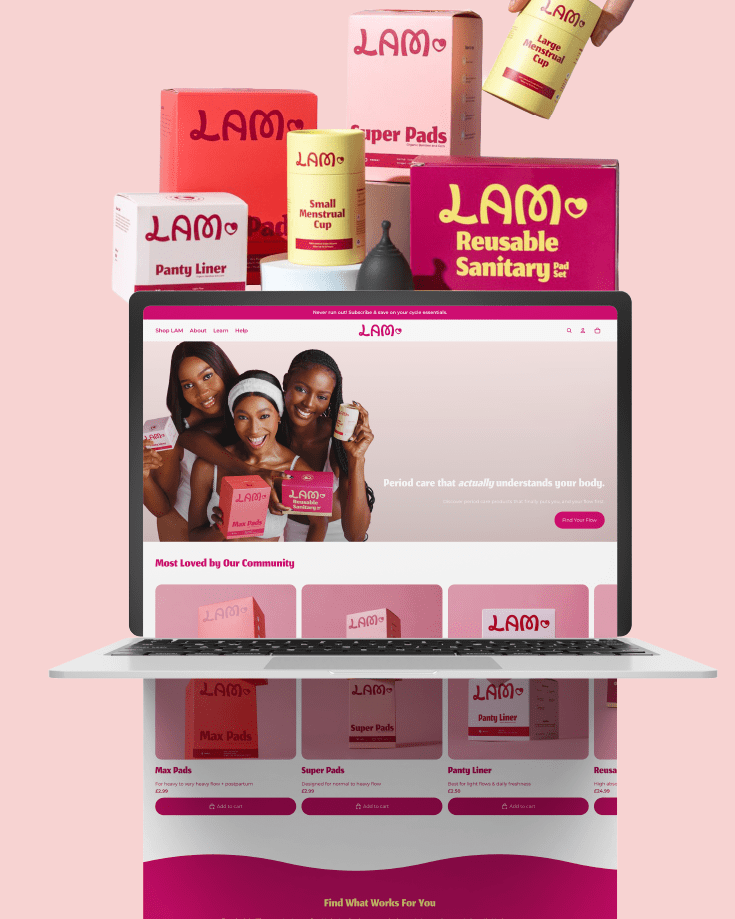
LAM is a menstrual care brand. In her first year of business she was already doing charitable work with mental health organisations, supplying period care products to schoolgirls in Nigeria, and building genuine expertise in menstrual health that went far beyond the products she was selling. She had the knowledge to guide women on which products suited their specific needs. She was an educator, not just a founder.
But surprisingly, none of that was visible on her website.
The site sold products. That’s it.
And for someone who wanted to pitch to retailers, who had real ambitions to be on shelves, her website at the time didn’t back the pitch.
She had the stats, the knowledge, the confidence to walk into a room and make the case. But when those people left the room and visited her website, what they found didn’t match what they’d just heard.
The depth was hidden. The credibility was missing. The innovation was invisible.
Her website relaunch wasn’t about a new look. It was about positioning her as a credible, purpose-driven brand with the ability to scale, so that the next time she walked into a pitch, the website was ready to back everything she said.
What Retail Buyers Actually See
When a buyer or stockist visits your website, they’re asking a specific set of questions whether they realise it or not:
- Does your brand look like it belongs on a shelf? Not just aesthetically, but does the professionalism of the site match the professionalism of the product? Does it look like a brand that takes itself seriously?
- Is there evidence that people buy this repeatedly? Reviews, subscriptions, UGC, sold out notifications. Anything that shows demand is real and consistent.
- Does your brand have a clear point of view? Is it obvious what makes your product different from everything else in the category? Or does it blend into the generic language every other brand is using?
- Is there depth beyond the product? Charitable work, educational content, community, mission. The layers that tell a buyer this brand has substance and staying power, not just a cool product and a nice logo.
If your website can’t answer those questions clearly and quickly, the pitch becomes harder than it needs to be.
What Changes When The Website Is Ready
A lot can happen in a year. Three years. Even a few months. And the business you’re running today is almost certainly not the same business you were running when you built your current website.
If you wake up and decide you want to be bigger than an online store then your website has to be ready to support that move before you make it.
If you know your products deserve to be somewhere beyond your existing customer base then again, your website has to be ready to support that move.
Not after you’ve already been in the meeting.
Not when a buyer asks to see your site and you’re suddenly aware it doesn’t reflect what you just told them.
Before.
Your website should be giving you the confidence to pitch, not making you hesitate about whether to send the link.
JAL Studios builds custom Shopify websites for scaling product brands preparing for retail, investor conversations, and significant relaunches. If your site isn’t ready to back your next pitch, the Growth Ready package was built for exactly this moment. Start here.
0 COMMENTS